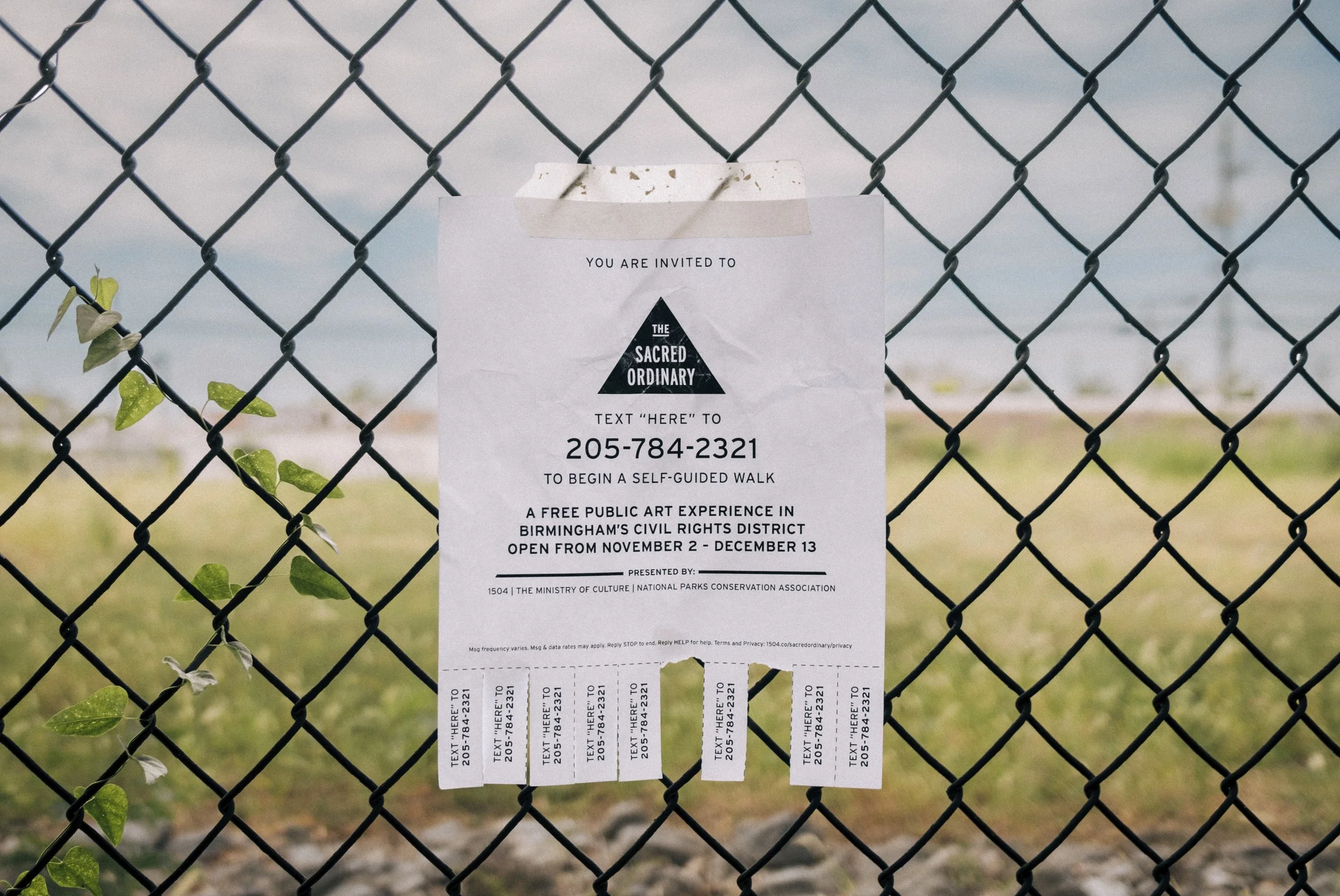
The Sacred Ordinary
Project Statement
“There are no unsacred places; there are only sacred places and desecrated places.” — Wendell Berry
The Sacred Ordinary is a public art installation exploring the relationship between people and places that hold public memory.
Our connections with places are among our oldest and deepest, yet language struggles to name them. For some people, places that have witnessed extraordinary moments can retain an energetic imprint that may still be felt across time.
Birmingham, Alabama, is known around the world for such places — sites of civil rights history that many regard as sacred and that connect us to something larger than ourselves.
But today, that memory is endangered.
Aging infrastructure, the passing of a generation of foot soldiers, and federal efforts to erase chapters of American history raise an urgent question: if institutions alone cannot sustain history, what role can the public play in caring for sacred sites?
As interpretive signage is contested nationwide, The Sacred Ordinary uses no visible markers, relying instead on overlooked objects of civic life such as newspaper vending machines, dumpsters, and telephone booths, placed at sites across Birmingham’s Civil Rights District. By day, they remain familiar objects; after dark, each glows from within as an instrument of attention.
Together, they reveal the physical and social infrastructure behind Birmingham’s freedom struggle, a movement led by ordinary people with moral imagination. Their work left a blueprint for collective action that is universal and timeless, but we now face a critical moment to ensure it’s not forgotten by the next generation.
The Sacred Ordinary invites visitors to consider the possibilities and limitations of preserving these stories.
The experience unfolds as a self-guided night walk, featuring a series of light installations and site-responsive sound design heard through visitors' phones. It opens with narration by actor André Holland, whose own preservation work includes saving a historic theater in nearby Bessemer.
Beyond Birmingham, The Sacred Ordinary imagines placekeeping as a shared civic responsibility, in which art creates embodied connections with the past and asks how to carry its unfinished work forward.